
The web development landscape continues to evolve rapidly, and platforms like Webflow have dramatically transformed how websites are built. As we move through 2026, many businesses and designers are asking: Is Webflow still a good choice?
The short answer is yes—for the right use cases, Webflow remains an excellent platform.
However, the longer answer requires understanding Webflow's position in the current market, its strengths and limitations, and how it compares to emerging competitors—including the significant product changes introduced through 2025 and 2026.
Webflow in 2026: The state of the platform
Webflow has undergone significant transformation since its early days as a visual web design tool. What began as a way to visually create custom websites without code has evolved into an increasingly AI-native platform focused on marketing teams. Webflow is positioning itself not just as a visual builder, but as a platform that helps teams build, analyze, optimize, and grow their web presence—with AI assistance woven throughout the workflow.
This evolution was accelerated through strategic moves. In April 2024, Webflow acquired Intellimize (an AI-driven personalization platform), and this, alongside launching Analyze and Optimize, shifted Webflow from design tools into marketing technology. In 2025 and into 2026, Webflow has doubled down on AI-powered site creation, code generation, answer engine optimization (AEO), and collaboration—all supporting a vision where marketing teams can launch, test, analyze, and optimize without heavy engineering dependency.
Recent updates and releases on Webflow
Webflow has been remarkably active in releasing new features. Here are the most significant updates:
- February 18, 2025 — Per-page JavaScript
Each page now loads only the JavaScript it needs, improving performance and reducing unnecessary site-wide JS. - July 10, 2025 — Webflow Interactions with GSAP
Native GSAP-powered interactions became available to all users, including SplitText, Staggers, ScrollTrigger, horizontal timelines, and reusable interactions. - July 21, 2025 — Webflow Cloud GA
Webflow Cloud moved to general availability, with full-stack app hosting and new storage options including SQLite, Key-Value Store, and Object Storage. - September 17, 2025 — Webflow Conf 2025 platform announcements
Major announcements included the revamped AI Assistant, AI code generation, React code components via DevLink, next-gen CMS, Content Delivery APIs, real-time collaboration, Analyze updates, and the AEO Maturity Model. - October 29, 2025 — AI-powered SEO & AEO tools
Webflow launched AI-assisted audits and generation for alt text, meta titles/descriptions, and schema markup to improve traditional SEO and AI discoverability. - February 5, 2026 — AI Site Builder improvements
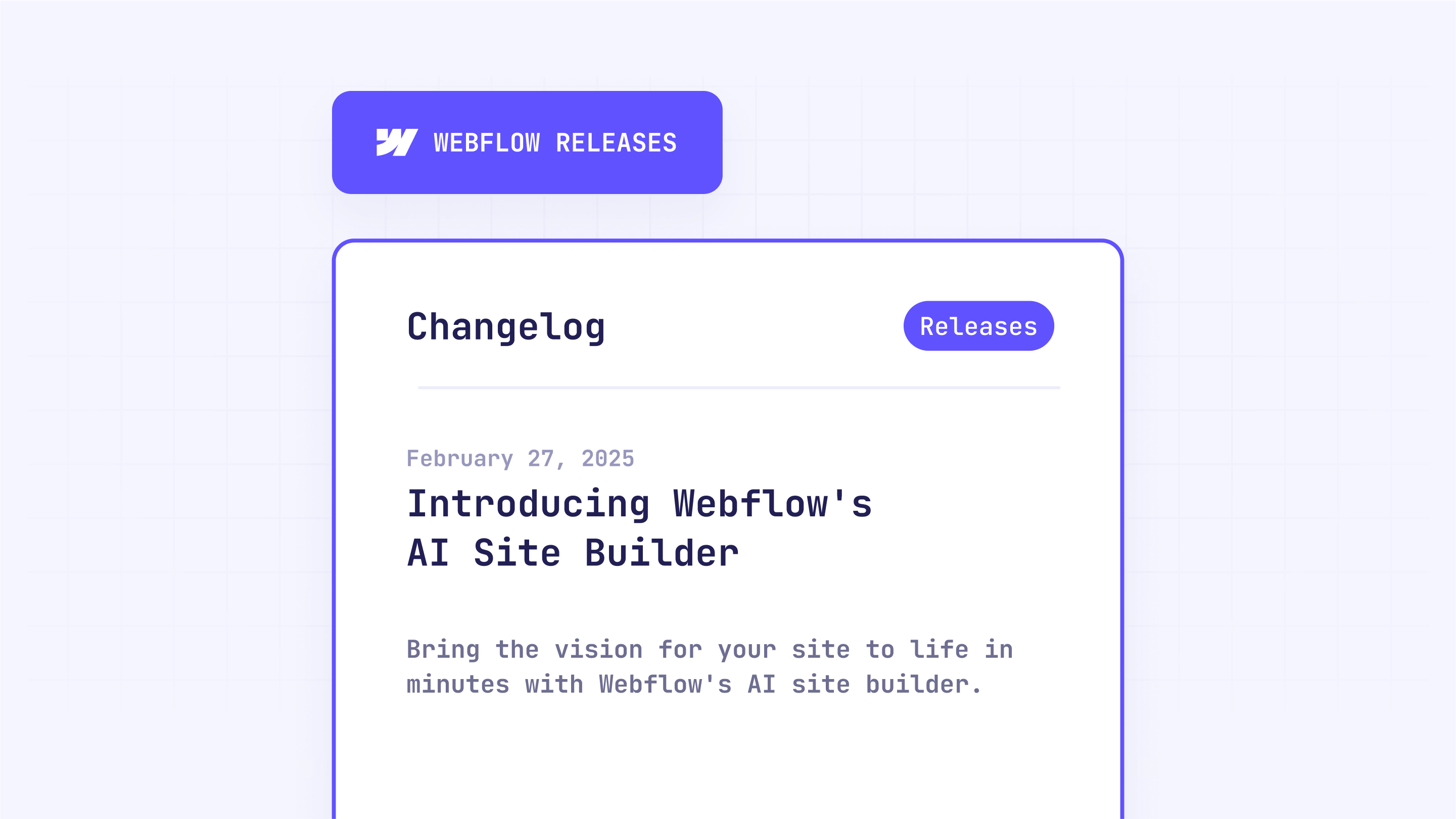
Webflow’s AI Site Builder gained multi-page generation, stronger design-system foundations, Flowkit-powered consistency, and had surpassed 60,000 published sites. - February 25, 2026 — Real-time collaboration GA
Real-time collaboration completed its GA rollout and became available across all sites and plans. - May 21, 2026 — Webflow AEO for Enterprise
Webflow AEO became available for Enterprise customers, combining AEO analytics with AI agents that recommend and help ship site improvements for AI answer engines.
These updates demonstrate Webflow's commitment to evolving beyond site building toward a comprehensive platform for building, analyzing, and optimizing websites—with AI and marketing teams at the center.
Webflow's current market position
Webflow has solidified its role as a leader in professional visual web development, particularly for marketing and design-led websites. The platform has gained traction with professional design agencies, marketing teams, and enterprise clients. Major companies like IDEO, Monday.com, TED, The New York Times, Philips, and Discord use Webflow for various web projects.
Webflow's new Platform plans introduced in May 2026—Team and Enterprise—signal a clear push toward larger organizations, offering features like AEO agents, publishing workflows, enhanced governance, and dedicated support. Yet, Webflow has maintained relationships with its core user base of freelancers and agencies through dedicated Freelancer and Agency workspace plans.
What Webflow does well in 2026
Webflow has continued to evolve its strengths in 2026, establishing itself as a leader in several key areas that make it an attractive platform for specific website needs.

Webflow's visual design excellence
Webflow continues to excel at enabling high-quality, visually distinctive websites. The platform is frequently used to build sites with rich interactions and animations. The acquisition of GreenSock (makers of the GSAP animation library) in 2024 has been fully realized with Webflow Interactions with GSAP, now available to all users at no additional cost. Features like SplitText, ScrollTrigger, staggered animations, and reusable interaction presets significantly strengthen Webflow's animation capabilities.
For designers seeking pixel-perfect implementation without coding, Webflow remains one of the strongest options available. The Designer allows granular control over every aspect of a website's appearance while generating clean, semantic code under the hood.
Webflow's content management for marketing teams
Webflow's CMS has matured into a powerful system for marketing websites. The ability to define custom content types visually makes it accessible to non-developers, while recent improvements like individual CMS item publishing, draft modes, and the next-gen CMS with Content Delivery APIs announced at Webflow Conf 2025 have streamlined editorial workflows.
After Webflow's May 2026 pricing update, the Premium Site plan includes 20,000 CMS items and 40 CMS Collections—a significant increase from the previous CMS plan's 2,000 items and 20 Collections. This makes the CMS more viable for content-heavy sites that previously needed add-ons.
For marketing teams, Webflow offers an ideal balance: developers and designers can build templates and design systems, while content creators can safely update the site without breaking layouts. This collaboration-friendly approach is a major selling point for organizations with mixed technical and marketing teams.
Webflow's performance and security
Webflow sites benefit from the platform's robust hosting infrastructure. All sites are served via a global CDN with static file publishing, resulting in fast loading times. Security is another strength—Webflow's closed architecture means there's no risk of plugin vulnerabilities, and the platform automatically handles SSL, backups, and other security measures.
Webflow Cloud, now generally available, adds the ability to deploy server-side logic and dynamic applications alongside Webflow sites—powered by Cloudflare's edge infrastructure. This expands what teams can build without leaving the Webflow ecosystem.
AI-powered site creation and AEO
As of 2026, Webflow has invested heavily in AI capabilities and Answer Engine Optimization (AEO):
- AI Site Builder: Generate multi-page sites from a text prompt, now used to publish over 60,000 sites.
- AI Assistant: Conversational AI within the Designer for edits, suggestions, and guidance.
- AI-powered SEO: Auto-generation of alt text, meta descriptions, and schema markup.
- AI Code Components: AI-assisted generation of React components that integrate with the Webflow canvas.
- AI traffic insights: Track visits from ChatGPT, Claude, and Perplexity directly in Webflow Analyze.
- AEO Maturity Model: A framework introduced at Webflow Conf 2025 for optimizing content visibility in AI-powered search results.
- AEO agents for Enterprise: Available since May 2026 for organizations on Platform plans, focused on technical and content optimization for AI answer engines.
These features position Webflow as a platform that helps marketing teams optimize for both traditional search engines and AI answer engines—a growing concern as AI-generated answers reshape how users find content.
Webflow's learning curve sweet spot
Webflow occupies an interesting middle ground in the ease-of-use spectrum. While it's not the simplest website builder available (that title might go to Framer), it offers significantly more power and flexibility than most no-code tools while remaining more accessible than traditional coding.
This balance has made Webflow particularly popular among professionals who understand web fundamentals but want to work visually. In 2025, Webflow's educational resources like Webflow University continue to be excellent, helping new users climb the learning curve.
Challenges and limitations of Webflow in 2026
Despite its strengths, Webflow isn't perfect for every project. Understanding its limitations is crucial for making informed decisions.
Webflow's platform boundaries and feature focus
In 2025 and early 2026, Webflow confirmed its ecosystem-first approach by sunsetting two native features:
- Logic was sunset on June 27, 2025. Teams that relied on native automation workflows now use third-party tools like Zapier or Make for automation.
- User Accounts was sunset on January 29, 2026. Teams that relied on native authentication and membership features now use third-party tools like Memberstack or Outseta for user management.
This confirms Webflow's strategy: focus on core competencies (design, CMS, hosting, analytics, optimization, AI) and rely on partners for specialized functionality. While this helps Webflow excel in its core areas, it means the platform isn't ideal for projects requiring complex backend logic or user authentication out of the box.
Webflow is not for complex web apps—though the gap is narrowing
Webflow is still not ideal for complex backend-heavy applications, advanced authentication systems, complex permissions hierarchies, deep database logic, or product-grade SaaS apps. That core limitation hasn't changed.
However, Webflow is more capable than before for dynamic and interactive experiences. Webflow Cloud (now generally available) enables full-stack app hosting with Next.js and Astro support, server-side logic, and database-backed applications. AI Code Components and DevLink allow React components to integrate natively with the Webflow canvas. These additions expand what can be built inside or alongside Webflow—but still don't make it a replacement for a full custom application stack in complex cases.
Webflow's Ecommerce limitations
Webflow's Ecommerce capabilities remain functional for simple stores and design-led commerce. However, Ecommerce does not appear to be Webflow's main strategic focus compared with AI, CMS, AEO, Analyze, Optimize, collaboration, and Cloud.
For small catalogs or design-focused stores, Webflow Ecommerce works well. However, businesses with more complex needs—large catalogs, subscription products, advanced promotions, inventory complexity, or omnichannel operations—will likely find Webflow's offerings insufficient compared to dedicated platforms like Shopify or WooCommerce.
Pricing: A more complex equation after May 2026
Webflow's May 2026 pricing update changed how teams should evaluate the platform. The introduction of the Premium Site plan, the consolidation of the former CMS and Business plans, and the greater importance of bandwidth mean that cost now depends heavily on actual usage.
The biggest shift: the former Business plan included 100 GB of bandwidth, while Premium starts at 50 GB base bandwidth. Sites that use more than 50 GB may need bandwidth add-ons, which can increase costs—especially for high-traffic or asset-heavy sites. On the other hand, Premium doubles the CMS item capacity to 20,000 items and increases Collections to 40, which benefits content-heavy sites.
The pricing impact depends on your bandwidth usage, CMS needs, Workspace type, billing cycle, and add-ons. There is no single answer—some teams pay less, others pay more.
Rather than covering every pricing scenario here, we recommend reading our full Webflow May 2026 pricing changes breakdown (which includes a calculator to estimate your impact), and our general Webflow pricing guide for help choosing the right plan.
Webflow vs. competitors in 2026
Understanding how Webflow compares to alternatives like Framer and WordPress in 2026 can help you choose the right platform for your specific project needs and team capabilities.
The Webflow vs. Framer dynamic
Framer has continued to grow as a compelling alternative to Webflow, particularly for designers seeking an intuitive, Figma-like interface.
Webflow is stronger for CMS depth: Compared with Framer Pro, Webflow Premium offers much more structured content capacity: 20,000 CMS items and 40 collections versus Framer Pro’s 2,500 items and 10 collections. It also has stronger publishing workflows, content APIs, site search, code components, and broader enterprise/marketing infrastructure.
Framer is stronger for included hosting value: Framer Pro includes 100 GB of bandwidth, while Webflow Premium starts at 50 GB. That matters for traffic-heavy sites, media-heavy pages, and AI/search crawlers. Webflow can scale bandwidth with paid add-ons, but the CMS advantage is less useful if bandwidth becomes the bottleneck.
Bottom line: Webflow is stronger for CMS-heavy, content-rich marketing sites. Framer is often better value for simpler sites that need less CMS depth but more included bandwidth.
Webflow vs. WordPress in 2026
WordPress remains the dominant CMS globally, powering approximately 59.5% of CMS-based websites. Its open-source nature and massive plugin ecosystem provide unmatched extensibility.
Where WordPress is stronger: Open-source control, lower infrastructure costs at scale, massive plugin ecosystem, and the ability to build virtually anything with enough technical resources.
Where Webflow is stronger: Visual design experience, lower maintenance burden (no plugin updates or security patching), built-in analytics and A/B testing, AI-powered workflows, and a streamlined editor experience for non-technical teams.
The trade-off is consistent: WordPress offers more flexibility at potentially lower cost but demands more technical upkeep. Webflow provides a more polished, secure, and integrated experience—especially for marketing teams that want to move fast without engineering bottlenecks—but at a higher platform cost, particularly for high-bandwidth sites.
A note for agencies and client workflows
Teams managing client sites on Webflow should be aware that the Legacy Editor is being deprecated in 2026. This affects agencies, freelancers, and client handoff workflows that rely on the older editing experience. If your team or clients currently use the Legacy Editor, plan to migrate to the newer editing experience to avoid disruptions.
Who should use Webflow in 2026?
Based on Webflow's current direction, it excels for these use cases:
- Marketing teams that need to build, manage, and optimize content without developer dependence
- Design agencies and freelancers building marketing websites with distinctive designs
- Freelancers who build and manage client sites professionally
- Startups and SMBs seeking professional websites without hiring full development teams
- Enterprise marketing teams needing content hubs with governance features and analytics
- Content-rich websites that benefit from a powerful CMS with high item and collection limits
- SEO/AEO-focused marketing sites that want built-in optimization for traditional and AI-powered search
- Teams that want to launch, test, analyze, and optimize without heavy engineering dependency
For help choosing the right plan for any of these use cases, see our Webflow pricing guide.
Who should consider alternatives to Webflow?
Webflow may not be the best fit for:
- Complex SaaS or product applications requiring advanced backend logic, custom permissions, or deep database operations
- Advanced ecommerce stores with large catalogs, subscriptions, complex promotions, or omnichannel operations
- Sites with very high bandwidth sensitivity where paid add-ons may push costs higher than expected—estimate your impact here
- Projects requiring full backend control or specific server environments
- Projects requiring advanced authentication, permissions, or database logic beyond what third-party integrations can reasonably provide
- Organizations that want full open-source ownership or very low infrastructure costs at scale
Conclusion: Is Webflow good in 2026?
Yes, Webflow remains an excellent platform in 2026—for the right projects.
It has matured into a powerful platform that handles the entire lifecycle of content-focused, design-rich websites—from building and hosting to analyzing, testing, and optimizing. The AI-powered features, GSAP interactions, Webflow Cloud, and AEO tools show continued investment in making marketing teams more self-sufficient.
However, Webflow has also become more focused on what it does best, rather than trying to be all things to all users. The sunsetting of Logic and User Accounts confirms this direction. And after the May 2026 pricing update, bandwidth has become a more important cost factor—teams should evaluate their usage carefully before committing.
For marketing websites, content sites, SEO/AEO-focused projects, and visually distinctive web projects where design quality and editor experience are priorities, Webflow continues to be among the best options available. Its visual approach strikes a compelling balance between power and accessibility that few competitors match.
Ultimately, the key to success with Webflow is understanding its strengths and limitations, then choosing it for projects that align with what it does best.
For a comprehensive technical comparison between Webflow and alternatives like WordPress and Framer, including performance benchmarks, feature breakdowns, and detailed pricing analysis, check out our in-depth platform comparison.










Join readers commenting on this post!